
Product Hunt Launch Secrets with Rajiv Ayyangar: From Tagline to PMF
If you’re building something in the AI wave right now, Product Hunt is still one of the best places on the internet to get in front of early adopters.
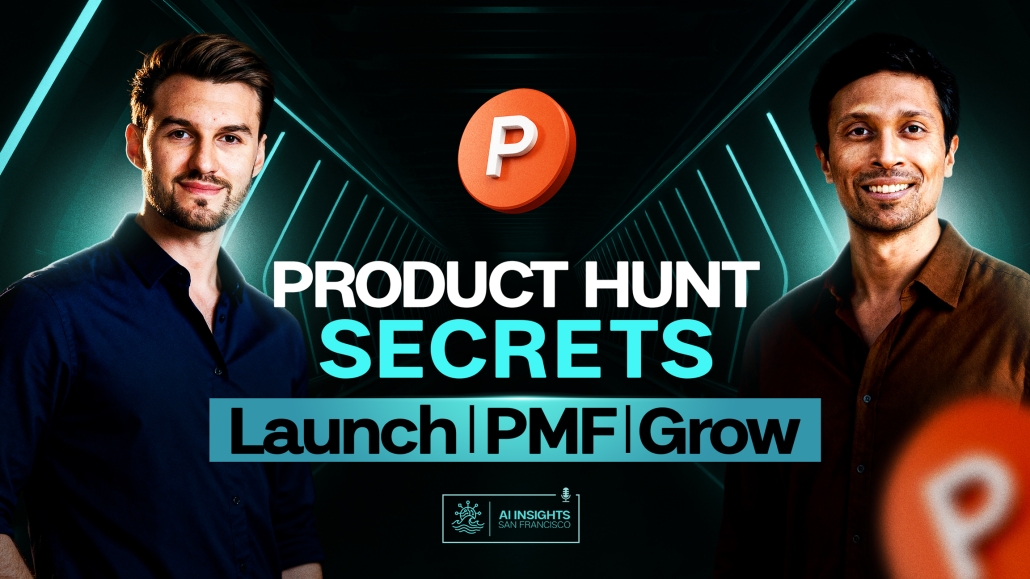
In this episode of AI Insights San Francisco, I sat down with Rajiv Ayyangar, CEO of Product Hunt, to unpack real, practical Product Hunt launch secrets, not hacks, not gimmicks, just what actually works for founders trying to launch, find PMF, and grow.
Why Product Hunt still matters for builders
Product Hunt started as a daily leaderboard of new products. Today, it’s:
-
A launchpad for new tools
-
A discovery engine for what the best builders are using
-
A community with Shout Outs and Product Forums where makers trade tips and feedback
Rajiv describes it as “a place where you realize you’re not the only weirdo in your friend group building things.”
“A Product Hunt launch is an open game anyone can play, no matter where you live.”
If you’re working on an AI product, dev tool, SaaS app, or anything in that space, your launch there is basically your public dress rehearsal for the rest of the internet.
No virality without clarity
Rajiv is blunt about the first rule:
“There is no virality without clarity.”
On Product Hunt, your 5–7 word tagline is doing almost all the heavy lifting. People scroll fast. If they don’t understand your promise in one glance, they move on.
“Those five to seven words in your tagline might be the most important copy you ever write.”
Founders love to say they’re building “an AI platform for everything.” That’s not a tagline; that’s a fog machine. Clear and specific always beats grand and vague.
Ask yourself:
-
Can a stranger repeat your one-liner to a friend without messing it up?
-
Would someone in your target audience instantly know whether it’s for them?
If the answer is no, you’ve found your first bottleneck.
Promise-market fit vs product-market fit
One of my favorite ideas from the episode is how Rajiv splits PMF into two stages:
-
Promise-market fit – Do people get excited by the promise you’re making?
-
Product-market fit – Does the actual product deliver on that promise?
“Promise-market fit is your ability to make a clear, compelling promise; product-market fit is your ability to keep it.”
A successful Product Hunt launch hits both at once:
-
The tagline + description make a sharp, specific promise
-
The product, once people try it, feels like it actually does that thing
If your launch gets attention but nobody sticks, you have promise-market fit but no product-market fit. If people love the product but nobody tries it, you might have the reverse.
How to find your one-liner (especially for AI products)
Complex AI tools are notoriously hard to explain. Founders want to say:
“We’re a flexible AI platform for end-to-end orchestration across agents, workflows and knowledge graphs.”
Cool, but nobody knows what that means.
Rajiv’s take:
“Great one-liners are earned in the wild, not invented in a vacuum.”
Some tactics that came up in the conversation:
-
Launch small and ask users:
-
“How would you describe this to a friend?”
-
“What’s the main benefit you get from it?”
-
-
Listen for what sticks. The words your users use are more valuable than your internal jargon.
-
Be concrete. “Virtual office for remote teams” or “apps from Google Sheets” are simple but powerful.
“If I can’t explain your product to a friend in ten seconds, it won’t spread.”
If you’re working on an AI tool, your first win is not “AGI-level intelligence.” It’s “I never have to do X by hand again.”
AI as a platform shift (and what that means for your launch)
Rajiv compares this moment to the early mobile era:
“AI is a platform shift, but the fundamentals of listening to users and shipping don’t change.”
Every product category now has an “AI-native” version emerging. But that also means noise. Launching just another “AI thing” won’t cut it.
Your edge:
-
A sharp problem statement
-
A focused use case
-
A community that actually cares about that problem
Product Hunt is less about “AI magic” and more about “Does this solve something real for me, today?”
Using Product Hunt like a laboratory
One thing I love from Rajiv’s mindset: treat your Product Hunt launch as an experiment, not a verdict.
“Founders overestimate how polished they need to be and underestimate how fast they need to launch.”
Instead of waiting until everything is perfect:
-
Get a working version.
-
Shoot a simple demo video: screen share + voiceover showing how it solves the problem.
-
Launch, listen, and iterate.
On the video specifically:
“Your launch video doesn’t need Hollywood polish; it needs to show the product solving a real problem.”
Builders on Product Hunt want to see the tool, not a brand film.
Real Product Hunt launch secrets (the simple version)
Here’s the distilled playbook from the episode:
-
Start with the tagline.
-
5–7 words
-
Clear, specific, tangible outcome
-
-
Write a promise users actually want.
-
“AI note taker for meetings” beats “Intelligent productivity platform.”
-
-
Record a straightforward demo.
-
Loom-style is fine. Show the UI. Talk through the use case.
-
-
Activate your community.
-
Tell your email list, Discord, Slack, WhatsApp groups you’re launching.
-
Ask people to comment, ask questions, and share their honest feedback.
-
-
Be present on launch day.
-
Answer comments
-
Clarify use cases
-
Treat it like a live user interview marathon
-
“Talk to people who tried a similar idea and failed; you either find a blind spot or deepen your conviction.”
And after launch, don’t vanish. Update your product, respond in the Product Forums, and keep refining your promise based on what people actually cared about.
Scaling what you built (when AI wrote half your code)
We also got into the reality of building with AI coding tools:
-
It’s easier than ever to ship an MVP
-
It’s still hard to maintain a large codebase
Rajiv mentions a wave of tools emerging for navigating and refactoring big codebases. The point for founders:
-
Don’t assume “AI built it” means you’ll never touch it again
-
Do think about how you’ll maintain, debug, and scale if your Product Hunt launch takes off
Your Product Hunt launch secrets don’t stop at launch; they extend into how you keep the thing alive once people actually care.
The deeper mindset: launch sooner, iterate in public
At the end of the episode, Rajiv brings it back to something simple:
“Great products are made through iteration, and you can’t improve if people never see it.”
This is the real meta-lesson:
-
Ship earlier than feels comfortable
-
Use Product Hunt as a feedback engine, not just a trophy shelf
-
Stay close to users in the forums and DMs
-
Let your tagline, product and roadmap evolve as reality pushes back
“Your first launch is not your final judgment; it’s your first real data point.”
“A quiet launch that teaches you something is better than a perfect idea that never ships.”
If you remember nothing else from this post, remember this:
“Launch sooner than you think – the internet can’t help you until your product is out in the open.”
How to use this episode
If you’re prepping a launch right now, here’s a simple way to use this content:
-
Watch the full AI Insights San Francisco episode with Rajiv.
-
Write three different taglines for your product.
-
Show them to 5–10 potential users and ask which one they’d repeat to a friend.
-
Ship a small version of your product.
-
Launch on Product Hunt, then hang out in the comments all day.
Then come back and improve. That’s where the real Product Hunt launch secrets pay off.
If you want more notes like this from AI founders, builders and platform leaders, you can:
-
Subscribe to the AI Insights San Francisco YouTube channel
-
Connect with me on LinkedIn
