

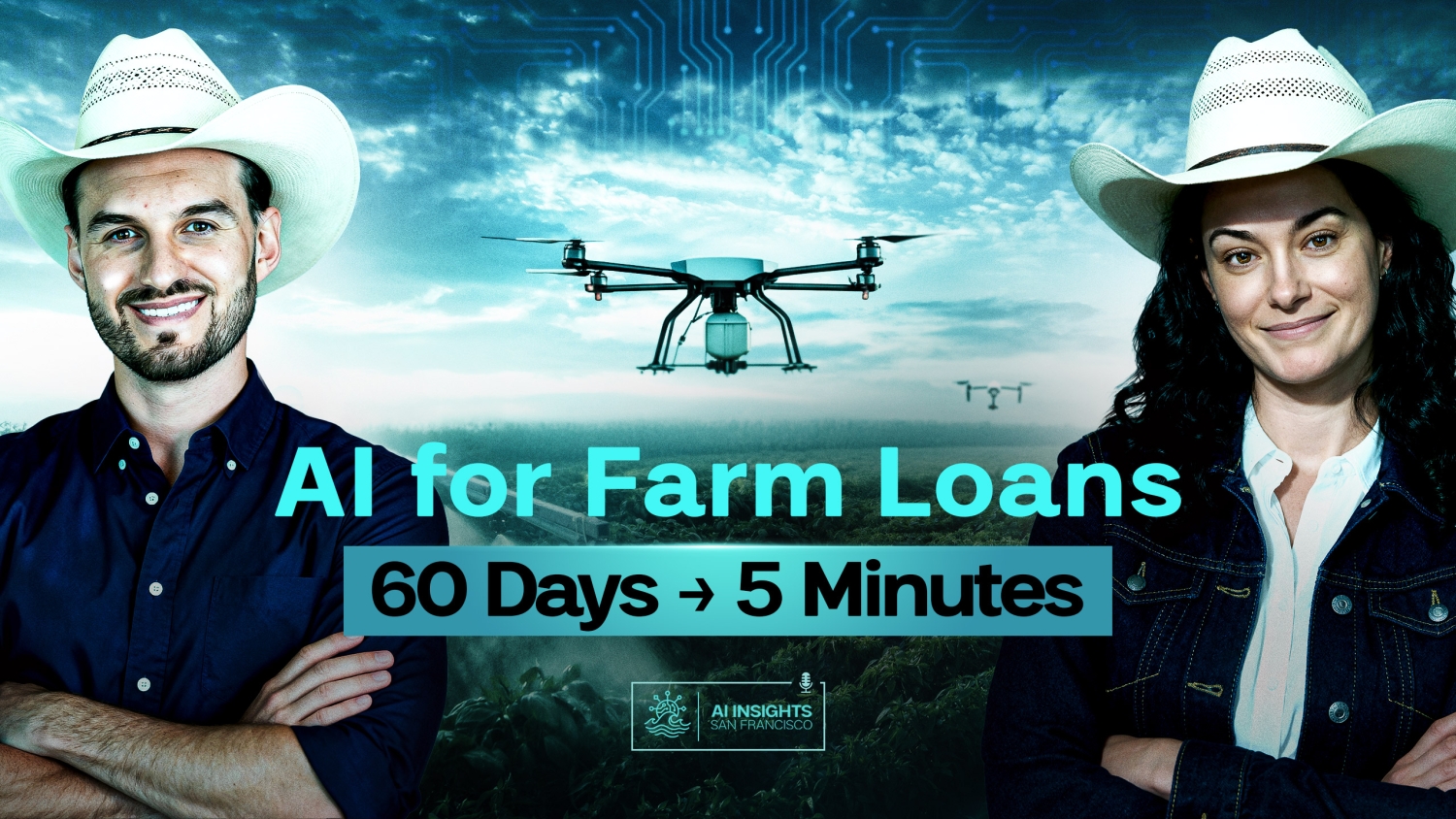
AI for Agricultural Lending, From 60 Days to 5 Minutes with Agxes
What this conversation is about
If you work anywhere near agriculture, finance or climate, you have probably heard a lot of buzzwords already. So let’s keep it simple.
This conversation is about one core idea
Right now, many banks take around sixty days to decide on a single farm loan
With the right mix of data and smart workflows, that decision can drop to under five minutes
That is what AI for agricultural lending looks like in real life. Not a robot in a field, but better, faster and more transparent credit decisions.
In this episode of AI Insights San Francisco, I sat down with Victoria Tostado Bringas, CEO and Co Founder of Agxes, to talk about how her team is rebuilding the way lenders look at farmers. We dig into:
-
Why agricultural loans are so painful to underwrite
-
How Agxes turns messy farm data into clear explanations for lenders
-
How this helps small and medium farmers finally show up on the radar
-
What new regulation means for lenders and why technology is no longer optional
It is a very grounded view of AI for agricultural lending, told by someone who has been both a grower and a founder.
What is AI for agricultural lending, in plain language
When I say AI for agricultural lending, I am talking about a system that:
-
Collects structured and unstructured data about a farm
-
Understands what that data means for risk and cash flow
-
Translates it into something a loan officer can read and trust
-
Documents every step so the decision is transparent and repeatable
Victoria describes it like this
“We are combining the raw data. We are making sense of unstructured data to analyze the farm, then we explain that to a person at a bank. We are using language models to explain in simple words what you are seeing in a satellite image, or what you are seeing in a market report.”
So the goal is not to replace people
It is to give lenders a much better view of what is actually happening on the land, without needing a room full of agronomists and data scientists.
Why farm loans are so slow and frustrating
Agriculture is one of the hardest sectors to underwrite. There is a lot going on:
-
Different crops, cycles and regions
-
Seasonality and weather
-
Water access and soil conditions
-
Market prices and logistics
Victoria explains the problem from her own experience as a producer
“Agriculture is one of the hardest loans to process because of the amount of information you need to analyze. You do not only analyze the farmer. You need to analyze the business, the operations and the cash flows. If you produce bananas and I produce strawberries, our cycles are different, our businesses are different, even if both are in the same region.”
Now imagine a lender with limited staff and time. They have a choice
They can spend sixty days analyzing a giant corporate client
Or sixty days analyzing a small or medium farmer
“They say it is going to take me sixty days to analyze Nestlé and sixty days to analyze Victoria. I will put my effort into the huge producer and disregard the small farmer because I do not have more time.”
This is where a lot of farmers become almost invisible to the system.
The communication gap, lenders vs growers
There is also a basic language problem between both sides.
Lenders speak in:
-
Ratios
-
Credit history
-
Compliance rules
Growers speak in:
-
Seeds
-
Fertilizers
-
Water, soil, equipment, harvest
Victoria captures this perfectly
“The lenders speak finance and the growers speak operations. They speak tons, fertilizers, trucks. It is hard for finance people to understand how this information translates into cash flows.”
So farmers end up doing a mountain of paperwork and explaining their operation from scratch. Even then, the lender might still not really understand how that translates into predictable cash flow and risk.
This is exactly the kind of gap AI for agricultural lending can help close, by turning operational signals into financial language.
How Agxes works behind the scenes
Agxes sits at the heart of this problem with an AI engine and a set of workflows that mirror the jobs humans do today in a lending team.
Some key ideas from Victoria
-
Making sense of messy data
Agxes pulls in raw data, including satellite imagery and operational information, and turns it into something structured and readable.
“We are combining the raw data. We are making sense of unstructured data to analyze the farm. We explain to the lender what they are seeing in a satellite image or a market report.”
-
Using deterministic models, not guesses
In lending, hallucinations are not an option.
“We are doing a deterministic model. We are using real information and real cases, and that is how we are avoiding these potential scenarios with hallucinations.”
-
Standardizing decisions and documenting every step
Today, a lot of decisions depend on the individual loan officer. That creates inconsistency and room for bias.
“With a system like Agxes, you follow a process that is standardized. You can demonstrate at every single stage how the decision was taken and what the thinking process was behind it.”
This is where AI for agricultural lending really shows its value. It is not just faster, it is also more transparent and more consistent.
From KYC to “know your farmer”
Most financial people know the term KYC, know your customer.
Victoria reframes it for agriculture
“We call it the cliff instead of KYC. We call it know your farmer.”
Instead of only looking at bank statements, legal documents and credit history, Agxes looks at:
-
Operations on the farm
-
Seasonality and cycles
-
Water access
-
Crop type and production reality
That means the lender is not only judging a farmer by their past financial record, but by the real potential of their operation.
This is a big shift in how risk is viewed and how opportunity is measured.
Regulation is pushing lenders in this direction
Even if a lender is not actively looking for innovation, regulation is moving in.
Victoria mentions a new policy that will require lenders in the United States to collect more than twenty data points for every small and medium business loan, including agriculture.
Done manually, that would mean:
-
More forms
-
More people
-
More time and cost
Agxes starts at the very beginning of the process and tracks everything through servicing.
“We step in since the know your farmer process. We collect all the data from the beginning to the servicing part. Everything is documented and standardized.”
This is another strong argument for AI for agricultural lending. It is not only about speed and accuracy, it is also about surviving the next wave of compliance requirements.
Fairness, bias and who gets funded
One part of the conversation that really stood out was around fairness and bias.
Victoria points out that women often get worse conditions when it comes to credit
“It is very well studied that women have less attractive conditions for loans. Women pay higher interests than men.”
When decisions are documented and the same rules are applied to everyone, it becomes much harder for hidden bias to drive outcomes.
“If now you can apply the same rules to every farmer and prove that through the system, you do not have that problem anymore and everything is transparent.”
So AI for agricultural lending is not just a technical upgrade. It is also a chance to rebuild trust and fairness into the system.
What changes for small and medium farmers
If platforms like Agxes scale, here is what it can mean in practice:
Faster answers
You do not wait months to know if you can plant, expand or invest.
More visibility
You are not automatically pushed aside just because you are not a giant corporate client.
Better storytelling
Your real operation, from soil to harvest, shows up inside the decision, not only your bank statements.
More confidence for lenders
They see a clear, documented path from data to decision, which makes it easier to back farmers they might have avoided before.
Victoria sums up the goal beautifully
“Farmers and regular people do not have to be technical. They just have to be good at their work. They can be seen and valued for their potential, not just as a sign of risk.”
That is the promise of AI for agricultural lending when it is done right.
Final thoughts
Agriculture has been around as long as humans. Finance has been around for centuries. Artificial intelligence is the new kid in the room.
The real magic happens not when we chase another buzzword, but when we combine all three in a way that actually works for people on the ground.
This conversation with Victoria is a clear example of that. AI for agricultural lending can:
-
Cut underwriting time from sixty days to minutes
-
Help lenders handle new regulation without burning out their teams
-
Bring millions of small and medium farmers into view
-
Build a more transparent and fair credit system
If you want to go deeper, check out:
-
The full episode of AI Insights San Francisco with Victoria Tostado Bringas
-
Books by Vaclav Smil on how we feed the world and how food systems evolve
-
Agtech and fintech resources that look at both tech and finance, not only machines in the field
- https://www.agxes.com/
Because sometimes the most important innovation is not a robot, it is simply giving one lender a clear, honest view of one farmer and letting a good decision follow from that.
